
Most collectors appreciate history, which is why they have a passion for vintage cars. With that passion usually comes an interest in the car’s provenance, the manufacturing process, and the legacy of the brand.
As a Cadillac nut, I had to stop in and visit some of the Motor City’s icons.
First on the list: Cadillac Place, the headquarters built in 1919 for General Motors. Designed b Albert Kahn, the ornate and stately building is a National Landmark and houses 1,800 offices. It was abandoned in 1996 for the Renaissance Center in downtown Detroit.
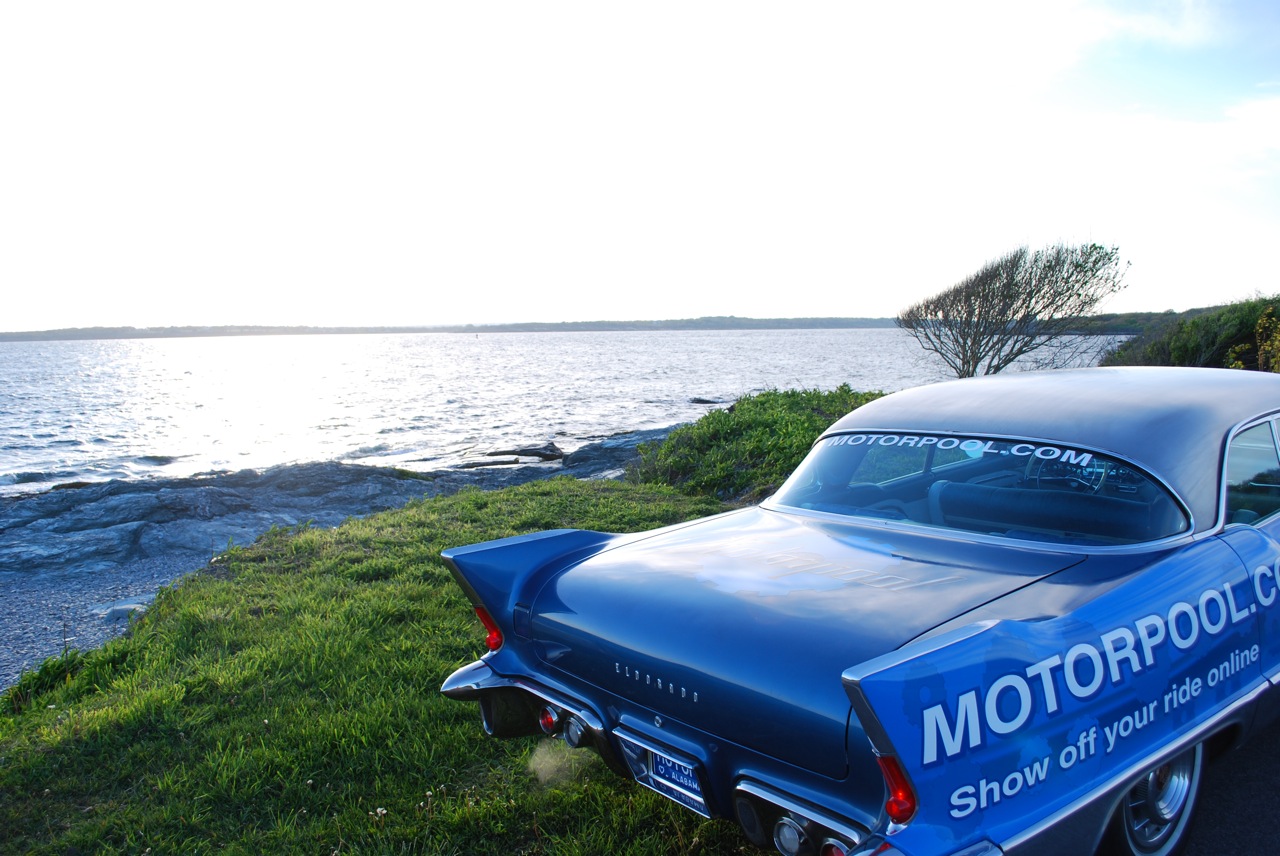
GM’s former worldwide headquarters. Somewhat larger than Motorpool.com’s
The Renaissance Center, GM’s current worldwide headquarters, was ironically the brainchild of Henry Ford II. When GM moved in the CEO quipped in the New York Times that he needed to give GPS devices to employees so they could find their way around.
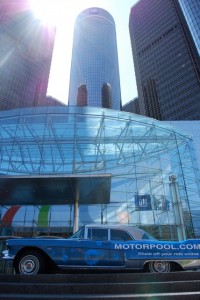
Parked in the CEO’s spot at GM’s Renaissance Center.
Lastly, my friend at Motorpool buddy, Walter Youshock, suggested I go by the Clark Street plant. There’s nothing left on the 47 acres that took over Cadillac production in 1921 and lasted until production stopped in 1987. The buildings were demolished in the 1990’s. Still, I drove the Brougham to its birthplace and strolled the vacant field until I found a brick remnant to take as a souvenir.
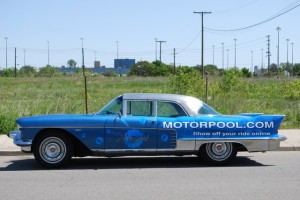
At the Brougham’s birthplace: Cadillac’s Clark Street plant.
Interested in more information about historical spots to visit in Detroit? Make sure you visit Motorcities.org. They’re a wealth of information and dedicated to preserving the Motor City’s automotive legacy.
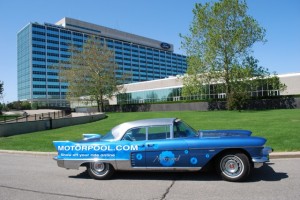
Parked at the “Glass House” in Dearborn–a truly beautiful HHQ for Ford.
http://www.nytimes.com/1996/05/17/us/gm-buys-a-landmark-of-detroit-for-its-home.html
GM’s Bankruptcy and Car Collectors
Those who collect GM products are among the company’s biggest supporters. Collectors of vintage Pontiacs, Chevrolets, Cadillacs, Oldsmobiles, Opels, Buicks, Hummers, and Saturns champion America’s largest manufacturer every time they back their baby out of the driveway.
Classic cars are rolling testament to their manufacturer.
So naturally, many of Motorpool’s enthusiasts have written me to say what a sad day it is to see GM taken off the New York Stock Exchange. Still, most collectors take the long view. Log onto Motorpool and you’ll see our database of classic and collector cars. That database (the world’s largest) was laboriously compiled, model by model, and includes many a bankrupt brand. In fact, there are over 6,000 makes and models on Motorpool–90 percent of which no longer exist.
Packard, Peerless, Pierce Arrow, Hupmobile, Sears, Alvis, and others–they’re long gone but still celebrated by colletors. The country didn’t fall to shambles with Duesenberg stopped production. The economy didn’t collapse when Tucker left the scene. America didn’t forget manufacturing when Kaiser took a dive.
Simply put: the auto business is a rough and competitive industry. Brands come and go. Only companies with superior products, skilled manufacturing, strong marketers, savvy competitors, dynamic dealers, dedicated employees, shrewd politicians, and willful industrialists survive. Today, as in days gone by, you can’t just be good at one or two of those–a company must excel at them all.
My guess: bankruptcy will give GM a good shot at restructuring into a company that can survive in today’s climate. I’m pulling for them to make the right choices to turn the company around.
Whooo Doggie
Those feeling blue in Detroit about the auto business departing should look to neighboring Indiana. Indiana used to be the car manufacturing headquarters of the United States. Hooziers built cars?
Oh yes. Fine ones.
One of the oldest names in cars, Studebaker, was made right here in Indiana. Studebaker, for those of you who don’t know, made the Conestoga wagon. That’s right, they made wagons before they made cars–and those wagons tamed the west.
For a glimpse of the last word in Indiana automobiles, don’t miss the Auburn Cord Dueusenberg Museum in Auburn, Indiana. Located in the gorgeous art deco headquarters of the Auburn Automobile Company, the museum encompasses over 100 extremely fine pieces of motordom.
What’s a Duesenberg, you ask? Only one of the finest automobiles ever to roam the earth. Fabulously expensive and ridiculously opulent, Duesenberg sadly went out of business during the Great Depression (what was so “great” about it?). Theatre lovers will remember it was the car that Daddy Warbucks drove in Little Orphan Annie. What else?
Grand cars with huge fenders, giant headlights, doors like steel vaults, and powerplants that could pull down a building, the Duesenbergs of the ACD Museum made my 1958 Cadillac feel like a Smart Car. In fact, the Eldorado looks positively modest and compact by comparison.
After a stroll around the glittering expanse of the museum, I motored down to Fort Wayne for an interview with the Fort Wayne Journal Gazette. You can catch the article on our cross-country trip here.
While there, the reporter recommended I have lunch at Fort Wayne’s famous Coney Island hotdog stand. What a great dive. The long lunch counter is a local institution, a must try. I ordered what any normal person would do in that situation: two chili dogs, a bowl of chili, a Coke in a bottle (they taste better that way) and a piece of coconut pie. I think indigestion must also be a local institution.
It was all extremely tasty.