
Lake Moses had been a pleasant place to stay for the evening and boasted many retro hotels/motel signs. As we continued east both Kim and I marveled at the stunning landscape. There are few towns but many blushed forests, arid buttes, and rolling potato fields.
Soon we came upon the tiny mining community of Wallace, Idaho. Its modest downtown contained many original Victorian buildings that seemed inviting. Yet we had an appointment in Missoula, so no time to dilly-dally. Lunch was at Ron’s, where we both had butterscotch milkshakes (delicious). Ron’s was built in 1957, so was the perfect vintage for the Brougham.
Thus far on the trip, I’ve driven my 1958 Cadillac Eldorado Brougham in excess of 10,000 miles. I’d say we’ve broken in the new engine rebuild by now. She runs powerfully, quietly, and doesn’t show the slightest sign of over heating. Running towards Missoula at 75 mph, the Brougham surged up mountains and stormed down hills. We made it to town in time for the interview on the local NBC affiliate and then checked into one of the nicest Holiday Inns I have ever visited. The very helpful reception staff recommended Lolo’s Steak House for dinner.
Kim, a vegetarian, managed to contain her enthusiasm, especially after the manager informed us that Lolo’s was heavily decorated by dead critters. “But they have crudites,” he helpfully added.
The drive out there boasted many stunning vistas of Montana. As promised, Lolo’s steakhouse was festooned with about 300 deceased creatures. Cousin Kim glared at me for most of the dinner over her baked potato while I happily scarfed down a delicious steak, my second of the adventure (and very reasonable at $14.).
On the way home, we visited Oxford. No, not the City of Spires, but rather the city’s oldest bar; a bar which has been in continuos operation for more than 100 years. The doors don’t have locks because the Oxford is always open, day and night, night and day. Locals told us that the bar was the sort of place you wiped your feet before stepping onto the sidewalk so as not to dirty up the street. We thought they we joking. That is, until we saw the odd assortment of cliental standing outside Oxford’s unlocked doors. So Kim and I wisely decided to skip this local attraction.
A Funny Thing Happened On The Way to Potato Land
Though beautiful, the Holiday Inn was warmish and I tossed and turned all night. I dreamt I was being chased by a giant Shell Oil truck. When I awoke with a start, I decided to go in search of coffee. In my family, the rule is no poking the bear until he’s had coffee.
Unfortunately, this wasn’t a Holiday Inn Express, so coffee was not complementary. (We’re a startup company, so riders pay their own way and the prez doesn’t drink coffee unless it is free.) Decaffeinated, I made my way out to the Brougham and began taking off the car cover while shouting to Kim over the din of a lawnmower.
Once we’d revealed Heavy, the groundskeeper stopped his mower and came over to chat with us about the car. After a few moments, Sam took out pictures of his grandchildren and his babies: a 1959 Oldsmobile and a 1975 Cutlass. Sam informed us that the Cutless was the best selling car of the 1970s and went on and jokingly offered me $500 for the Brougham. Sam wished us well on our journey and we set out for Idaho Falls, Idaho.
The drive down went even better than I could have hoped. Advancing the cars timing gave it lots of extra power on the highway. The drive was long, scenic, and devoid of traffic. Sometimes I wouldn’t see another car for over ten miles. The vast panoramas were breathtaking.
We were making such good time, in fact, when I stopped for gas in Melrose, Montana I decided to have a beer with my ten gallons of ethel. And this was the perfect place to have a beer. The gas station sign simply said “GAS.” The pumps were circa 1962, and they functioned as gas pumps should–it was the only time I’ve filled up on this journey and let the nozzle click off that it did not belch gasoline back at me. You could read the dial. The bar sign read “BAR,” so I sauntered in the dusty saloon and ordered a local favorite, Moose Drool.
Back on the road, Kim had now become Motorpool’s steno pool. Her typing skills made the six plus hour drive go a little faster. She spent today furiously pecking at the keyboard to help me catch up on the blog.
. . . which is why she didn’t see the tire in the road. There was no time to stop. Swerving for a tire fragment seemed like an extraordinarily bad idea. I inherited this driving philosophy from my mother, who, on a road trip in the 1970s, struck a coyote with our Oldsmobile Vista Cruiser. The coyote made the fatal error of stepping out in front of my mother, who’s mantra has always been, “never swerve for a squirrel, rabbit, cat, or dog–you’ll wind up in a dead in a ditch and the animal will scamper off to kill some other unsuspecting motorist.” I also vaguely remember her saying something about making sure to speed up if there was a deer in the road. Mama is convinced that a sudden deceleration would cause Bambie to come through the windshield rather than under the car.
My mother’s South Alabama words of wisdom rang in my ears as we hurtled closer to the tire. I held the wheel steady and centered the car over the obstruction, hoping we’d clear it. We didn’t.
“Ahhhhgghhaarh! What the hell was that?” Kim looked up from the computer, startled.
“A tire in the road, “ I replied. “Couldn’t avoid it. But I think we are okay.”
At that precise moment the Brougham died. As we were coasting to a stop in the middle of nowhere, I notice a large plume of gasoline trailing from the rear of the vehicle. Oh damn. (Those of you that who have wagered today would be another breakdown day, you are a winner.)
I grabbed the fire extinguisher and sprinted to the back of the car. Fortunately, we weren’t ablaze. However, I estimate we lost about four gallons of fuel before I could reconnect the gas line where it had come apart from the fuel filter. The tire had also ripped off the electrical wires supplying the fuel pump, leaving just one of the two attached.
I gazed northward to where we’d struck the tire, approximately 1.5 miles up the road. Maybe that little bugger is up there with the tire, I thought. I set off at a brisk clip to retrieve the connector wire.
I’ve cracked the code as to when the Brougham will encounter difficulty; we break down on days when I am wearing nice clothes. As I scanned the highway for this small, simple connector, an enormous 18-wheeler, carrying what must have been the dung of 1,000 cows, hurdled past, flinging great torrents of offal onto the roadside and any poor traveler who might be so unfortunate as to be looking for a 1958 Brougham part.
I looked up at the broad Montana sky, vainly searching for an answer as to why the poop truck had to be out today. It also occurred to me that the truck’s driver must have spotted my loud madras trousers from well over a mile away. Was it too much to ask that the Excrement Express get into the left lane as he passed me?
Upon reaching the scene of the crime there was no electrical connector to be found, so I paused just long enough to remove the tire from the roadway. Then I trudged back to see Kim. She brought me a nice, warm water bottle from the floorboard.
Ever the Boy Scout, I salvaged a copper alligator clip from a jumper wire I’d made back in Birmingham. With that clip, some spare wire, and electrical tape, I got us running again.
After an hour or so, we stopped in Dell, population 35. The Dell Mercantile made us feel like celebrities–“Hey, we saw you on the news last night!”
Soon thereafter, we reached Idaho Falls, just a few minutes late for Motorpool’s local CBS interview.
It’s back.
A crisp Idaho morning greeted cousin Kim and I as we strolled out to the Cadillac. I hopped in, pumped the pedal, and warmed the old car up. Kim made the grave error of patting the dashboard and saying, “that’s a good girl.”
“Don’t talk to her that way!” I interrupted, “This old shrew needs a good kick in the tailpipe not a pat on the dashboard!”
But it was too late. I glanced down. Sure enough, the generator light was on and staying on. Well, this generator had lasted 3,000 miles, a record. Most collectors don’t push their automobiles to perform as they did when they were new. After all, some people don’t drive their classics 3,000 miles in ten years, let alone in two weeks. I couldn’t afford to lose another three days on a generator rebuild, so alas, it was alternator time.
My first stop was AutoZone, but two helpful customers suggested I head to the nearby Starter Specialists. What did I have to lose? Not much, as it turned out. The shop quickly removed my original generator (which I carefully stashed in the trunk to rebuild back in Birmingham). They then found a one-wire Delco generator to install. Within 20 minutes, I had a working power source and even the gauge and warning light worked as they had originally. Wow. Why didn’t I do this in Dallas?
Oh yeah, to keep it original. The difficulty was mounting the air ride compressor. But as it too, was an aftermarket item, I fortunately didn’t have to worry about running oil cooler lines and such (the Brougham’s original compressor was oil cooled and would have been a huge mess in this situation). In fact, the compressor took longer to mount than the generator.
One hour after we pulled in, we pulled out with a new alternator. I also took the time to replace the Brougham’s negative battery strap with a new replacement from Mastermind.
We couldn’t leave Idaho without eating some potatoes, right? Blackfoot is the place to go for that. The world potato headquarters, Blackfoot sports a tiny potato museum. It’s chief attraction is a giant potato, complete with sour cream and butter. It also boasts a potato sack tuxedo and a portrait of Marilyn Monroe in a burlap bag. She looks good in the sack, which was no doubt the local joke here for years.
As my doctor is not reading this blog, I will share with you that my lunch at Rupe’s, a genuine Blackfoot drive-in, consisted of a baked potato, cheese fries, and a caramel milkshake. The milkshake tasted just like homemade ice cream–an incredibly delicious moment of shake.
Sated, and feeling every ounce of saturated fat, we motored on to Salt Lake City. Kim repeatedly asked, “Where’s the lake?” at five mile intervals. “I want to see that salt lake!” To be fair, I wanted to see it, too. Kim and I are both saltaholics. We adore salt. So a lake full of salt has a lot of appeal. Kim wasn’t giving up on finding it–even though darkness was setting, “Where’s that lake?” she asked a passersby at the gas station. “Where’s the lake?” she asked a tourist at the Mormon temple downtown. “Where’s the lake?” she asked the valet at the hotel. Finally, at dinner, she asked the waiter, “Where’s the lake?”
“Well, it’s kinda South of here about five miles. But it smells. It doesn’t drain. It just collects all the water from around here. And I wouldn’t call it so much a lake as I would sort of a marsh. You wouldn’t want to swim in it. It’s hard to see. But it does have salt.”
So we skipped the lake.
On to Big Sky country.
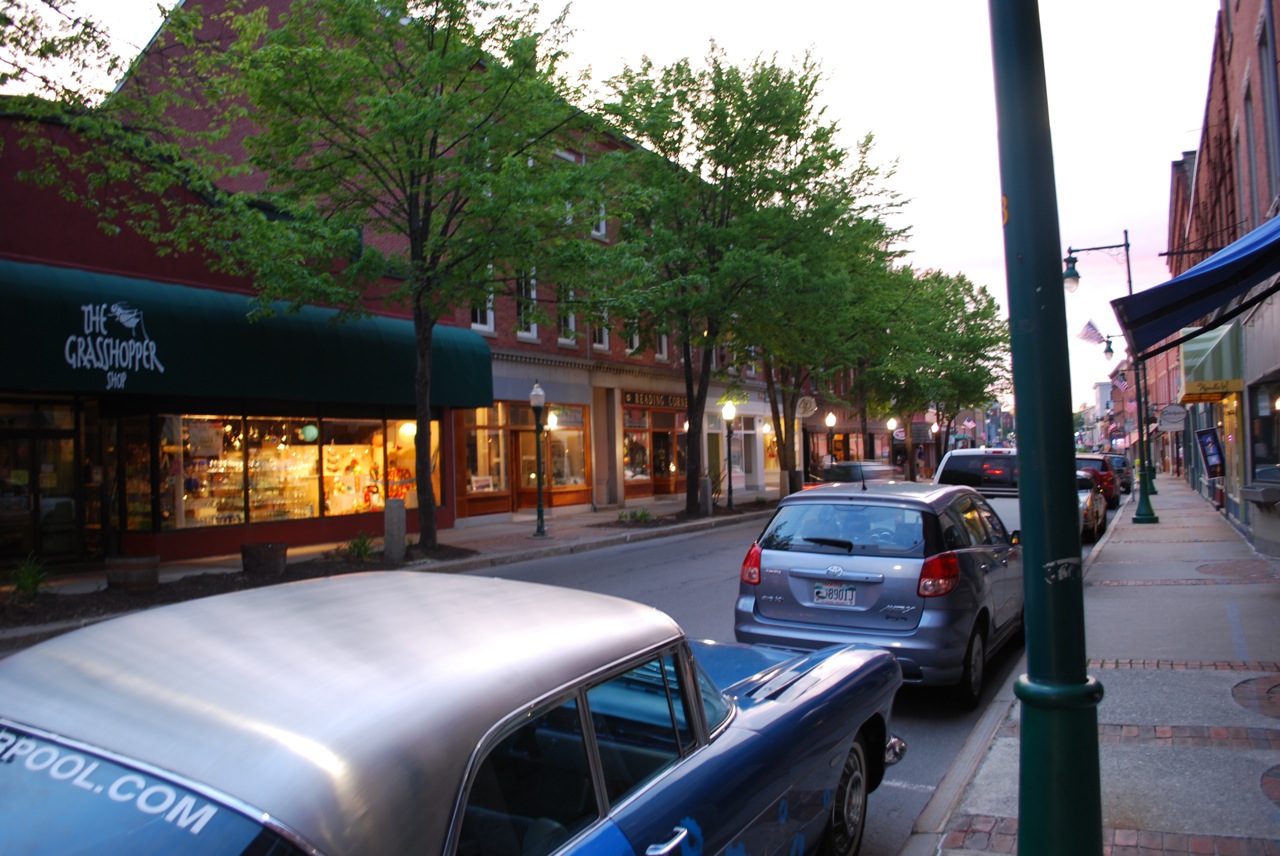
The drive from Salt Lake city to Cheyenne goes through a part of the world call “the badlands.” The badlands are so named because: a.) nothing grows there, b.) nobody lives there, and c.) only criminals and neredowells seem to visit. Despite its moniker, there many gorgeous mountains and overlooks to see. We frequently stopped at scenic vistas or stuck the camera out the side window of the Cadillac to take snapshots of Utah and Wyoming.
Cruising through the badlands.
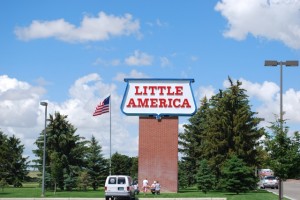
Soon we came to a rest stop named Little America.
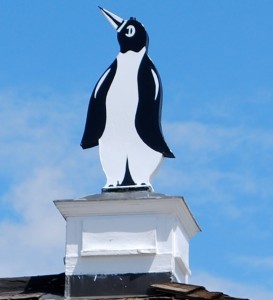
Little America was the name of Richard Byrd’s base camp in Antarctica, circa 1929. According to the legend on the back of Little America’s menu, (and you know if you read it in a menu it must be true), this rest stop in the middle of nowhere was inspired by the Byrd’s camp in Antartica. It’s slightly warmer but just as remote. It even has penguins. Penguin are every where in Little America. In the lobby. On the roof. Throughout the souvenir shop.
A bit of Americana in Wyoming.
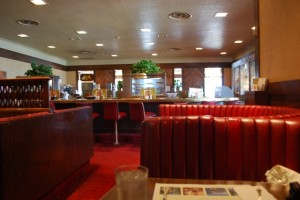
Cousin Kim and I sauntered into the restaurant to have breakfast. I ordered the cowboy omelet, which came with one of everything, including a diced cowboy hat. Cousin Kim, surrounded by the ambiance of a 1950’s rest stop, looked at our waitress and ordered, “a two egg-white omelet with onions, mushrooms, and no cheese.”
Just like in Antarctica. Except more remote.
The waitress blinked vacantly at Kim for a few moments. Undeterred, Kim added, “no, wait. Actually, I don’t think an egg-white omelet will hold together without the cheese. Do you have provolone?”
Rat Pack: eat your heart out, baby.
“Just order the omelet with cheddar,” I interrupted. Without pausing a beat, the waitress presumably wrote “w/cheese” and ambled off to the kitchen.
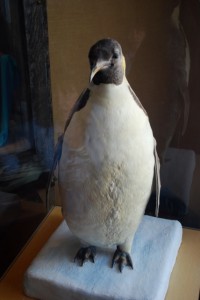
The real deal: from Byrd.
Three hours later our omelets arrived. By this time I had gnawed off half of the table, twice admired the clean restroom (the cleanest of the trip), and Kim had bought her brother, Martin, an expensive knife from the souvenir shop. The souvenir shopkeeper confided that she ordered lunch 30 minutes before her break, “Otherwise, it would take my entire lunch break before I’d get to eat!” So we weren’t the only ones.
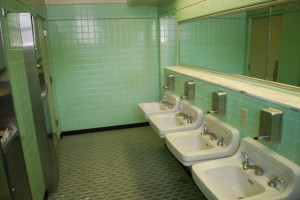
The very clean restrooms of Little America.
Yet when they finally arrived, our omelets were tasty. We managed to resist the 50-cent ice cream cone before getting back on the road for Cheyenne.
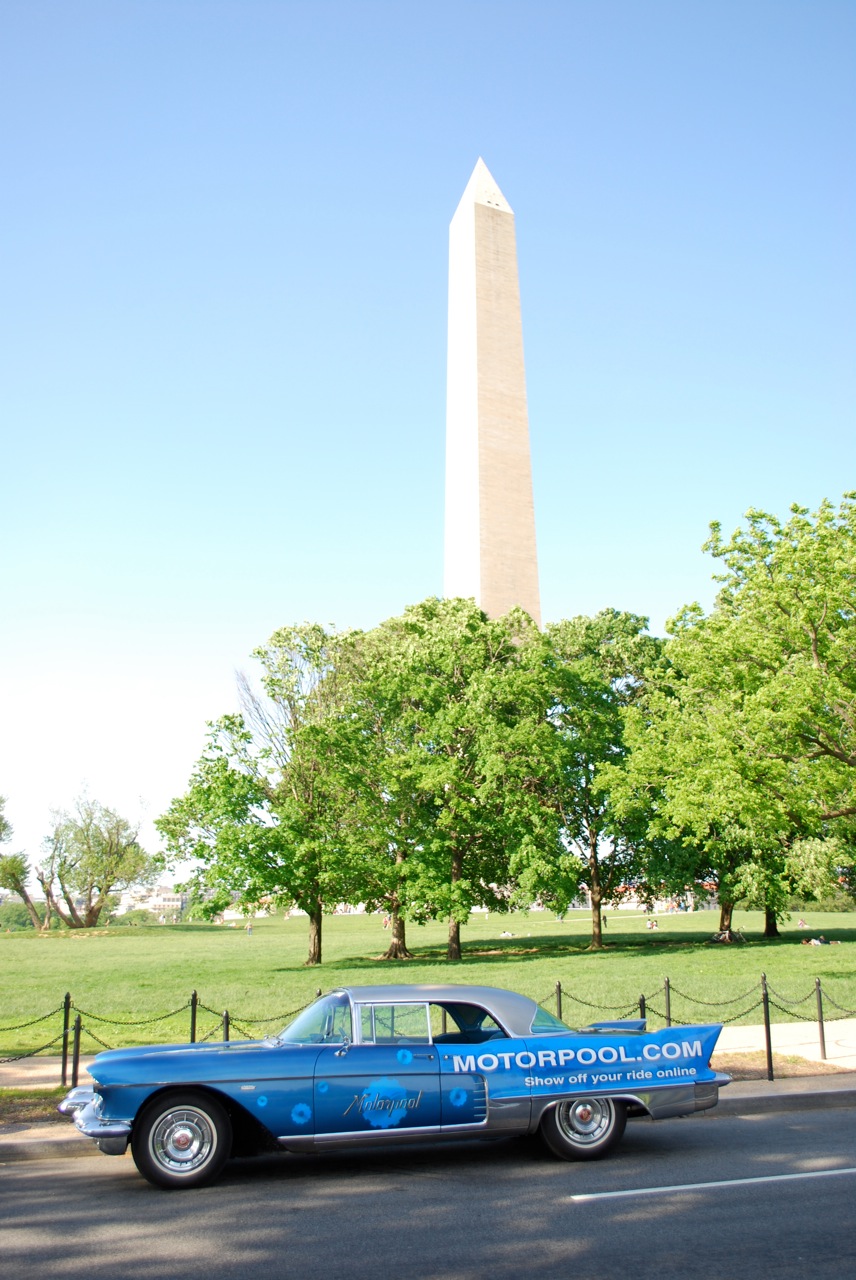
The gorgeous hills of the badlands.
Our next stop was Wamsutter, Wyoming, population 68, elevation 6,709 feet.
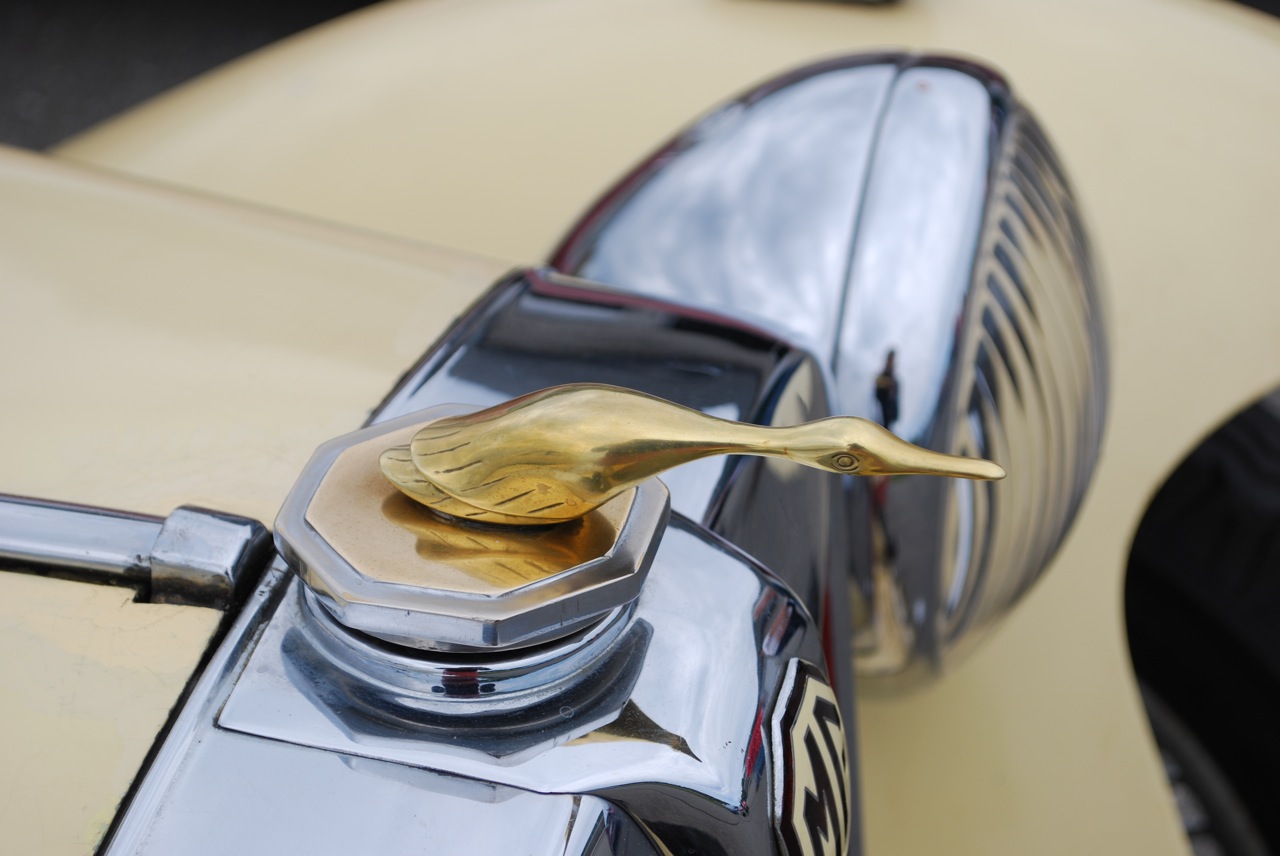
What a name.
I filled up the car and paused to have a Mexican Coca-Cola. What is the difference between a Mexican Coke and an American Coke? Mexican Cokes are still made with sugar. And for those of you who argue that there is no difference between cane sugar and corn syrup, you haven’t tried a Mexican Coke. I drank mine on the front bumper of the Brougham, which made a very suitable chair.
What the Dagmars were made for.
Soon thereafter, we reach Cheyenne. I’d left my flashlight and short screwdriver back in Seattle, so we went to Sears and bought replacements. Good thing, too. The altitude in Cheyenne was above 8,000 feet. Though the Brougham was performing much better than it had over the Continental Divide back in New Mexico, (thanks to the timing adjustment), it became apparent that we were going to have further altitude sickness.
Climbing, climbing, climbing.
Headed towards Fort Collins, Colorado, climbing hills became more arduous. After stopping for gas outside of town, I asked Kim to Google the elevations we would be climbing. One pass came back at 11,000 feet. I didn’t need a Brougham; I needed a billy goat.
Downtown Cheyenne.
So outside the Stop and Loaf gas station, in the fading light of the afternoon, I decided to attempt something I’d rather hoped to avoid. I resolved to take down the jets in the center carburetor from .065 to .060. Bravely, I began removing the air cleaner, various linkages, vacuum tubing, and nine (count ‘em) carburetor screws. Whew. I managed not to drop any small clips, retaining springs, or screws into the engine. Within a few minutes I had the jets changed. As darkness fell, he carburetor was coming back together. Kim helped me put the thing back together by placing one manicured finger atop the whole assembly. What a trouper.
Before putting the air cleaner back on the carburetors, I tested my handiwork by switching the car to the “on” position and letting the electric fuel pump run a few seconds. I instructed Kim to keep a weather eye out for any gas leak from the fittings. I neglected to ask her to keep an eye out for any gas geysers. Sure enough, the needles seat evidently lodged in the open position and soon gas was pouring all over the place.
Linkages, fittings, and hoses, oh my.
“How do you fix that?” asked Kim.
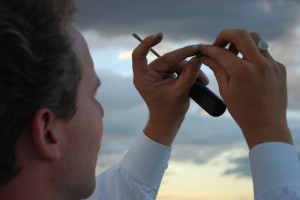
It weighed less than .00001% of the whole car. How can such a small part make a huge vehicle run so wrong?
“Hit it with a hammer,” I replied. And that’s exactly what I did. The needle seats in these old carburetors are prone to get lodged ajar by small pieces of debris. Kim and I had both noticed a fairly substantial pile of debris in the bottom of the carburetor’s float chamber. The new filters are simply not enough to catch all the trash coming from my lined tank. Happily, tapping the top of the carburetor with a hammer did the trick, halting the geyser of gas.
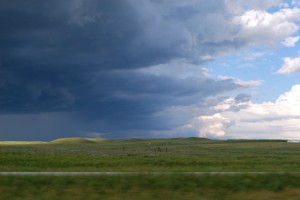
A Dorothy-special chased us into Fort Collins.
I need to try hitting more of this car with a hammer.
With the timing adjusted and the jets now back on factory specifications, the Brougham ran like a champ ll the was to Colorado Springs. I’d been reluctant to replace the jets, but now was exceeding glad I made that mechanical adjustment.