
Pulling into Fairfax, the Brougham began to overheat. Kelly Estes of Estes Automotive in Birmingham used a laser thermometer to measure my engine heat–the gauge, as it turns out, is pretty accurate. Halfway is probably 160 or thereabouts. At 3/4, I’m guessing I was heating the old classic up to around 240. Not good.
So I pulled over and had lunch.
Running at highway speeds, with the air conditioning on at full blast, the car runs around 180 degrees. But the minute I start lingering around town, or get stuck in traffic, she starts sweating like a hooker in church.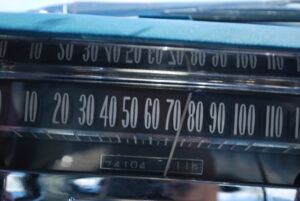
The ambient outside temperature today was just 83 degrees. I’ve had the radiator boiled and tested. The water pump was rebuilt. The engine, of course, was bored over .40, so that may cause her to cook a little hotter. And I’ve added some valves to the heater core, in case of malfunction. They are currently in the “off” position.
Thoughts, anyone?
Tamarak, West Virginia
Stopped at Tamarak for some Starbucks (thank God) and to check the air in the Brougham’s tires. The left front was 20 pounds, the right rear was 35 pounds.
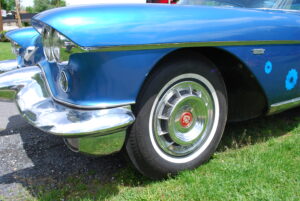
Everyone told me not to buy bias ply: they’ll ride rough, you’ll bounce all over the road, they’ll find a groove and stick with it . . . etc. But I’m a stubborn kinda guy, so I bought what the Lord and Harley Earl intended this car to drive upon: bias ply. In fact, I put the Brougham on 15 by 8 by 20 U.S. Royal tires with a proper 1-inch whitewall.
I bought them from Coker Tire in Chattanooga, Tennessee (www.cokertire.com) and Corky Coker himself checked out my wheels before we put them on the Brougham. “You’re doing this trip on the right tires. Bias ply!” he assured me.
They ride like a dream. Granted, I wouldn’t want to try any high-speed cornering in them, but that’s not the point of a Cadillac. These bias ply just ooze down the road, absorbing bumps and irregularities in the road with no problem. The tires are soft, comfortable, quiet and they look great. If you’re front end is in good shape, bias ply should be just fine.